When planning your child’s education in the United States, understanding the school system is essential. In our previous article, we covered how U.S. school districts work, how to choose the right one, and how platforms like Niche and GreatSchools evaluate school quality.
👉 Read the previous article: U.S. School District System & Selection Guide
Today, we’ll take a closer look at the U.S. school system: how it differs from Korea, and the key factors you should keep in mind when choosing a school in the U.S.
.
.
1️⃣ U.S. School System & Grade Levels
What Is a School System?
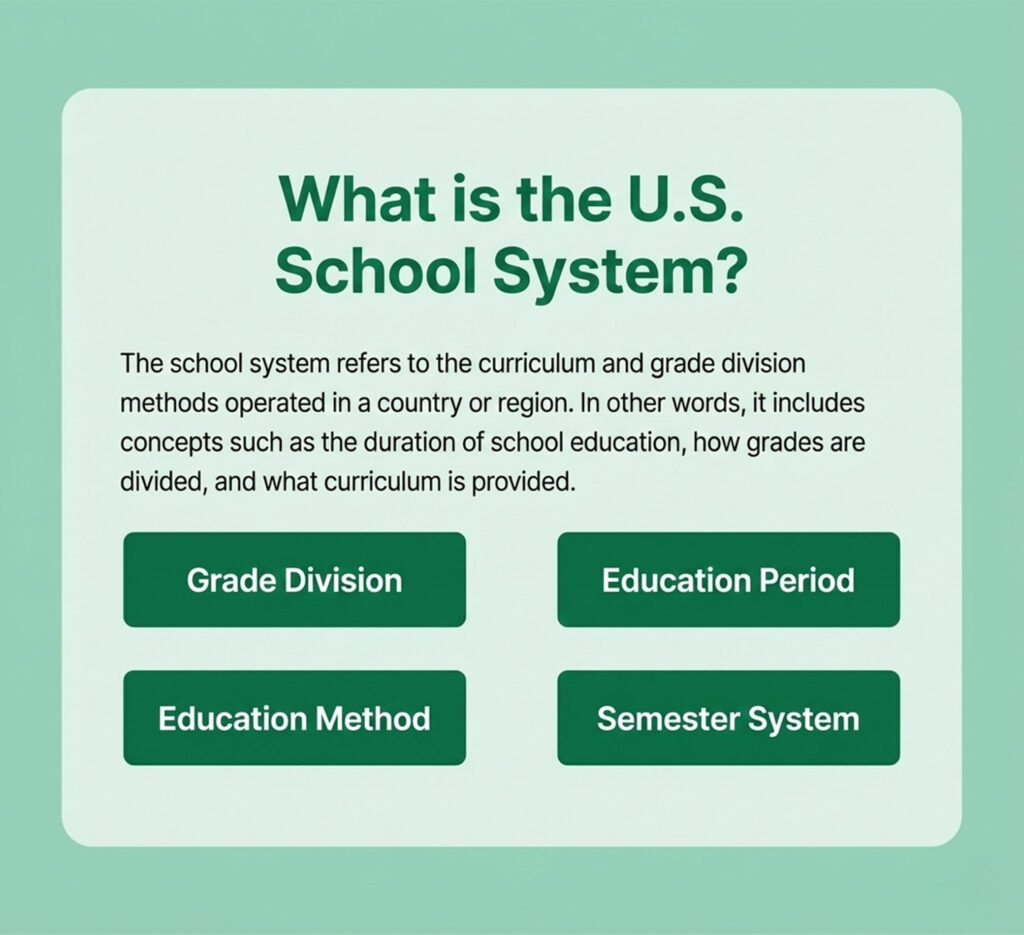
The U.S. school system refers to how a country or region organizes its academic structure, including how long students attend each level and how the overall progression works.
Below is a comparison of school structures in Korea and the United States:
.
.
Comparison of Korean and U.S. School Systems
| Category | Korea | U.S. |
|---|---|---|
| Structure | 6-3-3 (6 yrs Elem – 3 yrs Middle – 3 yrs High) |
K – 12 (Kindergarten – Grade 12) |
| Academic Calendar | Two semesters (starts in March) |
Two semesters (starts Aug-Sep) or quarter system |
| High School System | Year-based (fixed curriculum) |
Credit-based (course selection system) |
| College Admissions | CSAT (Suneung) **-focused |
GPA + standardized test (SAT/ACT) + extracurriculars |
- Grade Levels
- Korea: 6-3-3 (6 yrs Elem–3 yrs Middle–3 yrs High)
- U.S.: K-12 (Kindergarten–Grade 12)
- School Duration
- Unlike Korea’s 6-3-3 structure, the U.S. includes kindergarten as part of K–12.
- Compulsory education varies by state, but most states require schooling until age 16. Therefore, all students receive at least 10–11 years of education.
- Curriculum & System
- Korea uses a year-based model, while U.S. high schools typically operate on a credit-based system.
- Academic Calendar
- Korea: 2 semesters starting in March
- U.S.: 2 semesters starting in Aug–Sep or a quarter system (4 terms)
.
.
2️⃣ Public Schools vs. Private Schools vs. Charter Schools
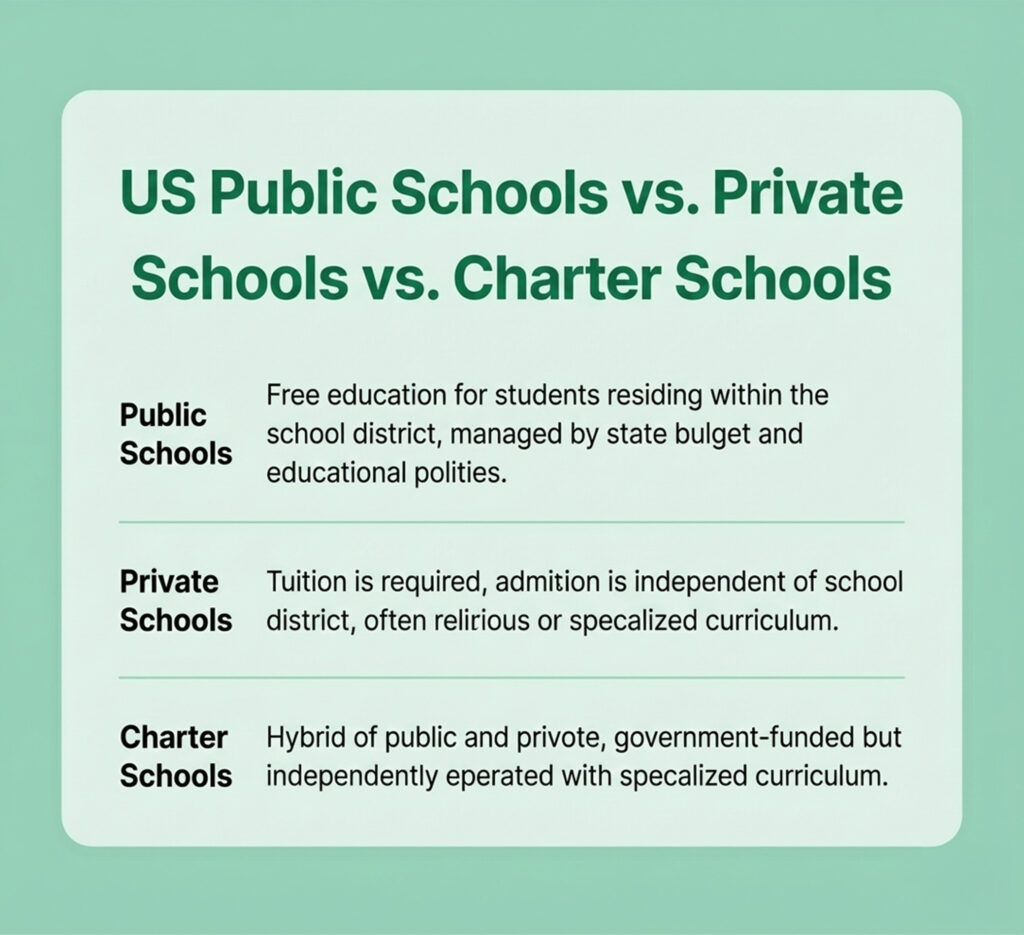
When choosing a school in the U.S., it’s important to understand the differences among public schools, private schools, and charter schools.
🔹 Public School
- Free education for students living within the school district
- Funded and regulated by state and local governments
- Quality varies depending on the school district
✅ Recommended if you live in a strong school district and want quality education without tuition costs.
🔹 Private School
- Tuition required; not restricted by school district
- Religious/specialized curricula offered
- Often have high college acceptance rates but can be costly
✅ Recommended if you want tailored or religious education, or want high-quality schooling regardless of district.
🔹 Charter School
- Hybrid between public and private schools
- Publicly funded but independently run
- Often focus on specialized programs (STEM, arts, languages)
✅ Recommended if you want flexible, specialized education without the high tuition of private schools.
.
.
3️⃣ U.S. High School Curriculum
1. Core Courses (required subjects)
| Subject | Description |
|---|---|
| English / Language Arts | 4 years required; literature, writing, reading analysis |
| Mathematics | Minimum 3 years; Algebra, Geometry, Pre-Calculus |
| Science | Minimum 3 years; Biology, Chemistry, Physics |
| Social Studies / History | U.S. History, World History, Government & Economics |
| Physical Education (PE) | 1 – 2 years in some states |
| Health Education | Required in some states; nutrition, mental health, etc. |
💡 Some states also require Foreign Language credits.
2. Electives
| Subject | Examples |
|---|---|
| Foreign Languages | Spanish, French, Chinese, Japanese |
| Fine Arts & Music | Art, Photography, Drama, Band, Choir |
| Computer Science & Technology | Programming, Web Development, Cybersecurity |
| Business & Economics | Accounting, Marketing, Entrepreneurship |
| Engineering & STEM | Robotics, AP Physics, Engineering Design |
| Psychology & Sociology | Psychology, Sociology, Philosophy |
💡 Students choose electives based on their interests, strengths, and college plans.
.
.
4️⃣ College Admission Process
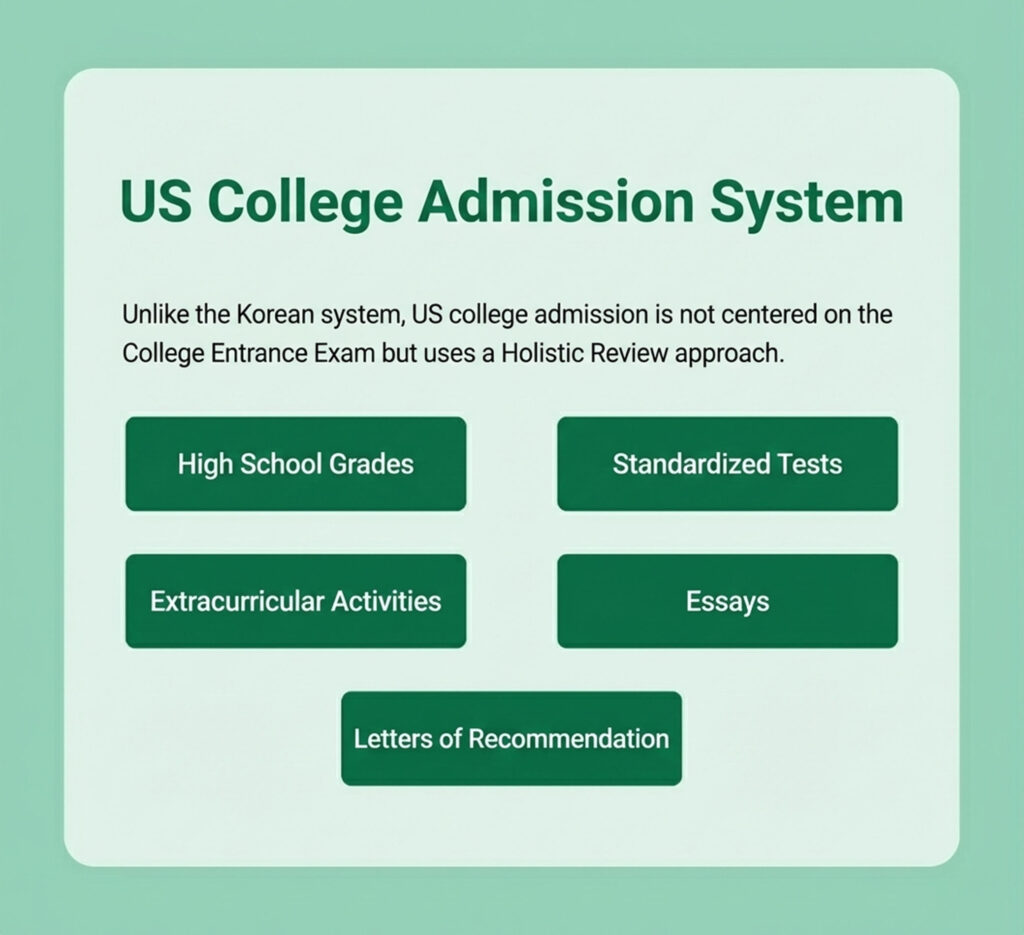
Unlike Korea’s CSAT-based system, U.S. universities use a holistic review process.
📌 Key Evaluation Factors
- High School GPA (Grade Point Average)
- Standardized Tests (SAT/ACT)
- Extracurricular Activities
- College Essays
- Letters of Recommendation
✅ U.S. admissions focus on the student’s story, potential, and personal development, not just test scores.
.
.
5️⃣ What to Consider When Choosing a School in the U.S.
Choosing a school—and therefore a place to live—can significantly shape a child’s future.
📌 Things to Check When Choosing a School
✅ Quality of the school district
✅ School type (public vs. private vs. charter)
✅ Student’s interests and career goals
✅ Extracurricular and specialized programs
✅ College acceptance rates and average SAT/ACT scores
Have you familiarized yourself with the U.S. school system and its grade structure, school types, high school curriculum, and college admissions?
If you’re evaluating school districts and planning where to live in the U.S., be sure to check out our detailed guide on how to choose and evaluate school districts.
In our next article, we’ll take a closer look at advanced academic programs such as AP (Advanced Placement) and IB (International Baccalaureate). 🎓