
📝 Who Works in the Underwriting Stage?
- Processor (Processor): they organize your documents, verify the completeness of items, and pass everything to the underwriter.
- DU/LPA(Automated Underwriting System): AI algorithms developed by the two major housing agencies (Fannie Mae and Freddie Mac). Your loan must receive initial eligibility approval here.
- Underwriter: The final judge. They verify that the automated results match your actual documents (income, assets, etc.) and issue the final approval.
You’ve submitted all your documents, the appraisal is finished, but it’s been days with no update from the lender. Feeling anxious, wondering “Did something go wrong with my loan?”
You’re now in Underwriting, the core of the mortgage process. This is where your file is checked to make sure it meets both U.S. financial regulations and the lender’s internal guidelines. Today, we’ll walk you through the must-avoid behaviors to ensure your file passes smoothly.

1. Who Actually Reviews My Documents in Underwriting?
Both people and automated systems work together.
✅ Review System in Underwriting
| Reviewer | Details |
|---|---|
| Processor | Organizes (scrubs) documents and checks for missing items before sending to the underwriter. |
| DU/LPA | Automated underwriting systems by Fannie Mae and Freddie Mac; provides the first-level eligibility approval. |
| Underwriter | The final decision-maker who verifies all documents and issues final approval. |
2. Underwriting Criteria & the Three Major No-Go Behaviors
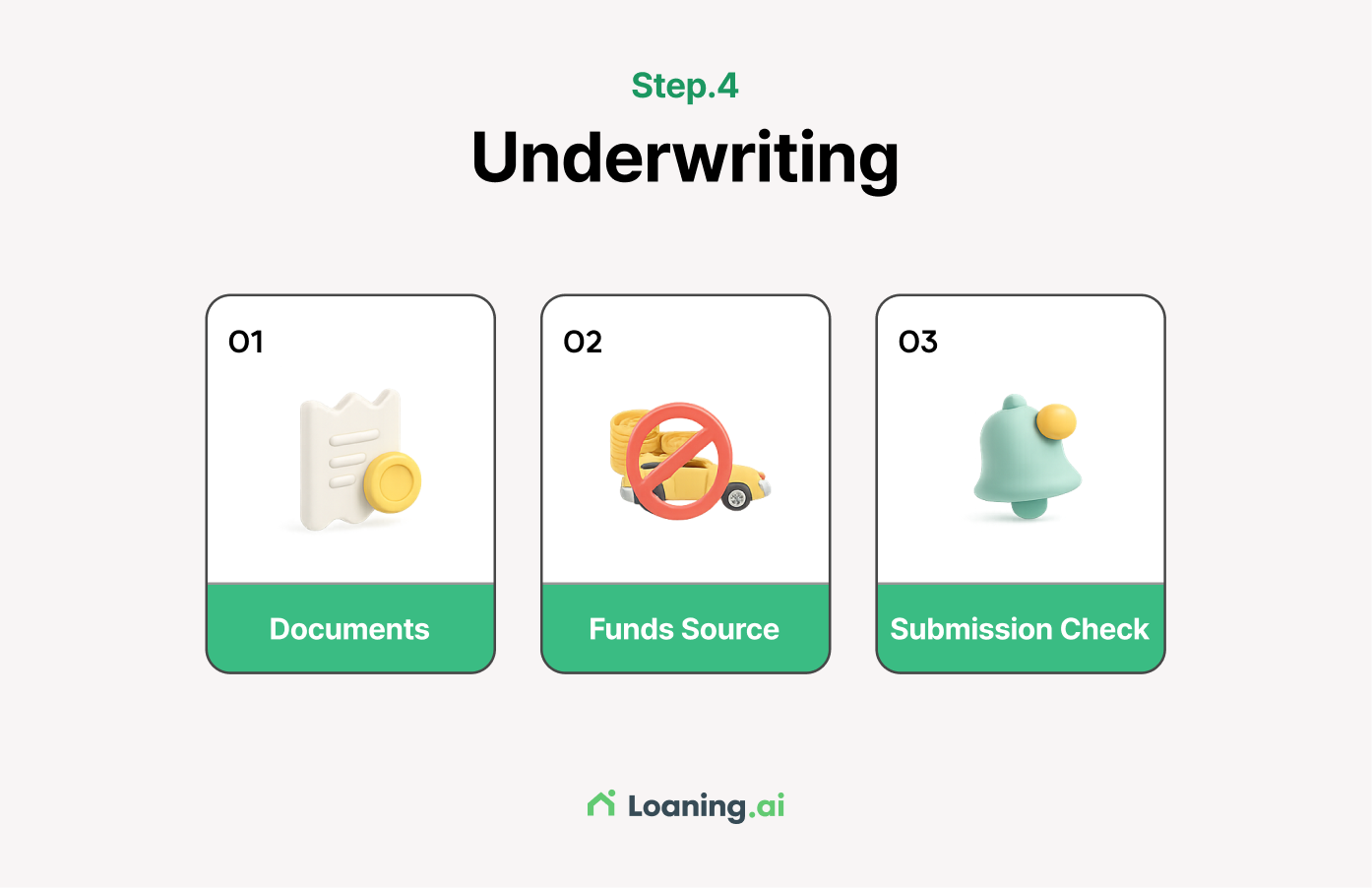
Once the processor’s document package reaches the underwriter, the true Underwriting begins. Four major areas are examined simultaneously:
✓ Property: appraised value, condition, property type (single-family, condo, townhouse), HOA risk
✓ Loan Program: fixed/ARM, LTV, DTI standards, program-specific rules
✓ Compliance: TRID, disclosure timing, documentation format, required disclosures issued correctly
✅ Types of Underwriting Outcomes
| Outcome | Description |
|---|---|
| Approved | Very few or no conditions; requirements already satisfied. |
| Approved with Conditions | Additional documents or explanations are needed, but approval is achievable once all are met. |
| Suspended | Key information missing, making decision difficult. |
| Declined | Cannot be approved under current structure (may need different program or loan structure). |
✅ List of Don’ts During Underwriting
| Don’ts | Why |
|---|---|
| Making Large Deposits | Any unusually large deposit outside regular income raises suspicion of borrowed funds or even money laundering and may require prove the source. |
| Taking on New Debt | Opening new credit or getting a car loan changes your DTI and can cause your loan to be denied right before closing. |
| Changing Jobs | Quitting or switching jobs can disrupt proof of income stability. If you plan to move, wait until after closing. |
3. What to Do If You Receive Conditional Approval
When the underwriter issues a conditional approval, the processor will compile a list of conditions and share them with you.
- Letter of Explanation (LOE): A written explanation for large deposits or irregular transactions.
- 48-Hour Golden Time: Submit requested documents or LOEs within 48 hours to stay on track for your closing date.
| Category | Required Documents |
|---|---|
| Income Conditions | • Additional recent pay stub • YTD Profit & Loss statement • Updated verification of employment (VOE) |
| Asset Conditions | • LOE + supporting documents for large deposits • Bank statement for the account holding your down payment |
| Property/Third-Party Conditions | • Appraisal-related items (e.g., photos showing completed repairs) • Extra documents required by HOA • Updated insurance binder with revised coverage |
They’re items you must satisfy for the underwriter to finalize approval.
Conditions are typically classified into PTD and PTF:
Yes. Most of the time is spent reviewing your documents and processing the file. If an issue comes up, your loan officer or processor will contact you immediately.
If you’re worried, feel free to reach out to us anytime 🙂
Perfect Scrubbing = Faster Approval
Delays often happen because the initial document package wasn’t properly organized.
At Loaning.ai, a professional processor thoroughly scrubs your file from the very beginning.
Conquer the toughest part of the mortgage process with Loaning.ai’s expertise 🙂
✓ Pre-check for risky transactions (e.g., large deposits)
✓ LOEs prepared in advance for expected questions
📝 Quick Checklist
| Checklist | Details |
|---|---|
| Current Stage | Have you confirmed with your loan officer whether your file is currently with the processor or in underwriting? |
| Condition List | Have you received the full list of conditions requested by the underwriter, either as a document or by email? |
| Document Preparation | Have you organized and prepared all required documents and explanations (e.g., LOE) for each condition in one batch? |
| Submission Confirmation | After submitting your documents, have you checked with the processor to confirm that each condition has been cleared and that no items remain outstanding? |



![Things to Check When Your Closing Disclosure and LE Don’t Match [Mortgage Guider Ep. 6]](https://blog.loaning.ai/en/wp-content/uploads/2026/01/6-350x250.jpg)
![Revised LE & Rate Lock: What to Do and When [Mortgage Guide Ep. 5]](https://blog.loaning.ai/en/wp-content/uploads/2026/01/5-350x250.jpg)
![How to Escape Third-Party Pitfalls: When the Appraisal Comes in Lower Than the Purchase Price [Mortgage Guide Ep. 3]](https://blog.loaning.ai/en/wp-content/uploads/2026/01/3-350x250.jpg)