✓ How to Fund Home Repairs and Maintenance
✓ Major Renovations vs. Minor Repairs: Comparing with HELOC
✓ Smart Renovations That Increase Home Value
Unlike Korean apartments, American homes require consistent maintenance. Repairing roofs, replacing old plumbing, and remodeling outdated kitchens are essential investments that go beyond simply improving quality of life—they preserve your home’s value.
But are you putting off necessary repairs because the tens of thousands of dollars in construction costs seem daunting?
Instead of dipping into your savings or using high-interest credit cards, there’s a smarter option many homeowners choose.
It’s home maintenance refinancing, which taps into your home’s potential equity.
.
Bankruptcy Refinancing: Waiting Period
If you wish to refinance after bankruptcy, you must carefully observe the ‘seasoning period’. The seasoning period refers to the time required for a loan applicant to demonstrate financial stability after bankruptcy. This period varies depending on the type of bankruptcy filed.
For example, let’s say your home is currently worth $500,000 and you owe $300,000. You take out a new mortgage for $400,000, pay off the existing $300,000, and receive the $100,000 difference in cash (minus closing costs). You can then invest these funds into home improvements that boost your property value, such as roof repairs, kitchen remodeling, or new flooring.
The primary advantage is the interest rate. Mortgage rates are significantly lower than those for personal loans or credit card debt.
Additionally, if you use the cash-out funds for home improvements, the interest on that loan may be tax-deductible, making it a financially efficient strategy.
.
Comparing Home Maintenance Refinancing vs. HELOC: Major Renovations vs. Minor Repairs
If your existing mortgage has an exceptionally low interest rate (e.g., 2-3%), you might prefer not to touch it. In that case, a HELOC (Home Equity Line of Credit) could be an alternative. You should compare which option is more advantageous based on your specific renovation plans.
| Feature | Cash-Out Refinance | HELOC (Home Equity Line) |
|---|---|---|
| Structure | Replaces existing mortgage with a new one |
Keeps existing mortgage, adds a second loan |
| Interest Rate | Mostly Fixed Rate (Stable) |
Mostly Variable Rate (Fluctuates with market) |
| Disbursement | One-time Lump Sum | Draw as needed within limit (Revolving) |
| Best For | Major renovations requiring a lump sum |
Long-term projects or uncertain costs |
.
Smart Renovation: Spending Money to Make Money_Home Maintenance Refinancing ROI
Not every repair increases your home’s value. If you’re spending significant money on home maintenance refinancing, you should invest in items that will be recognized as adding more value when you sell your home later. This is called the return on investment (ROI).
Home Maintenance Refinancing: An Investment Strategy to Enhance Your Quality of Life and Increase Your Home’s Value
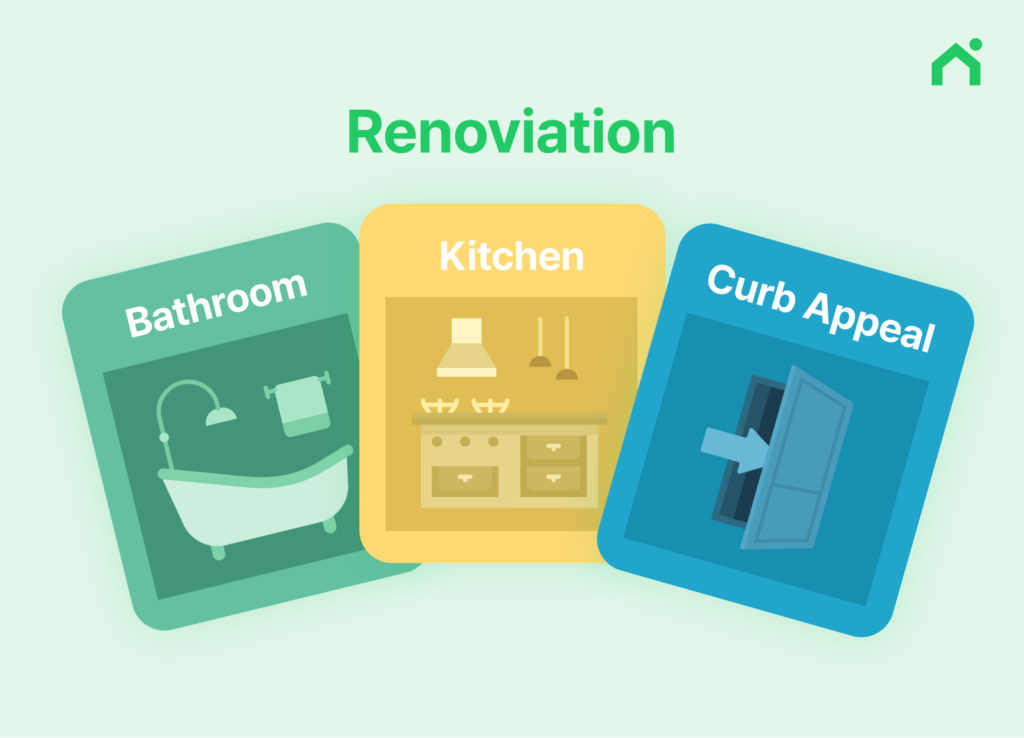
Simply replacing outdated tiles and the vanity can instantly give your entire home a modern look.
The kitchen is the first thing buyers look at. Painting cabinets, replacing countertops, and installing energy-efficient appliances are upgrades that offer the best return on investment (ROI).
Exterior improvements that define your home’s first impression—such as replacing the entry door, fresh paint, and landscaping—can significantly boost property value at a low cost.
.
Home Maintenance Refinance Checklist Before Applying
Get Construction Estimates First
You need to know exactly how much is required to determine the loan amount. It’s advisable to secure funds with a 10-20% buffer over the estimated costs. Unexpected variables during construction (plumbing issues, material cost increases, etc.) always arise.
Check the LTV (Loan-to-Value Ratio)
Typically, you can only borrow up to 80% of your home’s value. Calculate your current home value and remaining debt to ensure the available cash is sufficient to cover the renovation costs.
The 6-Month Rule
Did you purchase your home recently? Most lenders require at least 6 months to pass after purchasing a home before allowing a cash-out refinance.
.
Frequently Asked Questions
As mentioned earlier, essential costs such as appraisal and recording fees do apply.
However, you can minimize this burden by leveraging Loaning.ai’s Lender Credit policy. In fact, many of our clients secure liquidity using our “No Out-of-Pocket” option, which requires no upfront cash.
There are no restrictions on how you use the cash-out funds. You are free to use them for home improvements, tuition, business investments, or any other purpose.
Additionally, since these funds are classified as debt rather than income, they are generally not subject to income tax. This is a significant tax advantage.
(Note: We recommend consulting with a tax professional for specific tax advice.)
Adapt flexibly to changing lifestyles.

Our lifestyles are constantly changing, and life often brings unexpected events without warning.
Loaning.ai provides tailored services that best fit our customers’ situations during these moments of change.
If you’re wondering, “How much cash can I get for my home right now?” feel free to contact us anytime.